Showing posts with label medicine. Show all posts

Wednesday, December 12, 2012

Woman grows nails instead of hair

A young woman in Memphis, Shanyna Isom, began producing nails instead of hair after an allergic reaction to steroids back in 2009.  This doesn't only affect the hair on her head, but the hair all over her body.  As such, she now needs others to help her move around and even with 25 different medications to help control the condition, can only walk with a cane.  She has consulted doctors all over the country and even one in the Netherlands, but none of them have been able to diagnose her.  It is a true medical mystery.

Source: WMC-TV
More pictures and a video can be found at the WMC-TV news site.

Learn how you can help at the SAI Foundation, founded in order to help Shanyna with her medical bills, as well as others with undiagnosable illnesses.

Saturday, September 08, 2012

Review: When Surgical Tools Get Left Behind I & II

Tonight on the Discovery Health channel I watched When Surgical Tools Get Left Behind, parts I and II.  Objects left in a patient after surgery is a major problem, as about 1,500 people in the U.S. alone learn first hand every year (source). There is even a national safety project devoted to preventing retained surgical objects, No Thing Left Behind, which details safety procedures such as "Sponge Accounting" (apparently two thirds of the objects left behind are sponges, called gossypiboma; the sponges are tiny little gauze things that look like tissue once they're soaked with blood).   These objects can cause severe complications down the road, including pain and infection, and when the body encapsulates the object in tissue, they can be mistaken for tumors.

Among the retained objects featured in the show were a retractor (a metal object about the size and shape of a ruler), sponges and gauze, a plastic tube (left shoved down a kid's throat!) and a 9-inch clamp.  In one case the object caused an infection by flesh-eating bacteria (which was cured by packing the wound with bleach-soaked gauze) and another caused gangrene of the ribs. Other common side effects were depression, PTSD, and painkiller addiction.

Overall, the show was pretty mediocre, with the sequel being slightly better than the first.  It was fairly informative-- it explained the procedure of counting surgical equipment before and after an operation, and showed a new way of using barcodes to do so.  It also gave a lot of good background information about the likelihood and risk factors for having a tool left behind.  But many of the cases ran into each other after the first twenty minutes.  I found myself wishing they featured more large objects, or else a wider variety of objects (which the second did, I suppose).  Even though sponges were the most common, and could cause just as terrible complications, they got a bit old to watch.  I would definitely still recommend it if nothing else was on, but I wish I'd watched Doctor Who instead.

Overall: 2.5/5 skulls


Sunday, August 26, 2012

Phantom limb pain

A phantom limb is one of the more strangely horrifying side-effects of surgery.  A phantom limb is the sensation that an amputated (or otherwise missing) limb/other appendage is still attached to one's body.  But often the phantom limb feels tense or painful.  What can you do about pain in a limb that isn't there?  What else can go wrong in that limb?

A woman who was born with only three fingers on her right hand, which was later amputated, found out in a strange way.  Well, something didn't go wrong, exactly.  It's more like something went freakishly right.  Her two missing fingers "grew back" on her phantom limb after the real one was amputated, which shows something about how our brain recognizes what we "should" have in/on our body.  Her new fingers came back shorter, but a mirror box was used to lengthen them.

The article did not mention any pain in her phantom hand.

Tuesday, July 17, 2012

Chronic Skin Picking

Chronic Skin Picking (or Pathological Skin Picking, or dermatillomania) is something I first really learned about from A&E's Obsessed (which I will review later).  It's similar to hair pulling, or trich, which is another impulse control disorder.  Except, y'know, with skin instead of hair.  As I was watching an episode about a poor girl who compulsively picked at her skin, I began thinking-- I sometimes pick at my skin.  I always thought it was normal.  I knew it was bad, but what if-- what if what I thought was normal was actually this disorder?  Or what if I didn't have it yet, but all it would take was one really horrible event in my life to trigger it?

Sitting there late at night, alone, of course I didn't think that this chick has a hole in her cheek and that therefore I likely did not have the same disorder. (I, myself, do not have a hole in my cheek.) I also remembered in the morning that I have actually had this conversation with many people who all admit to having picked at pimples, dead skin, cuticles, scabs, or some combination thereof.  It seems like one of those pretty normal things that everyone does but nobody talks about until you get caught doing it.  Surveys show that 60-80% admit to picking at their skin to some level, at some time.  But only about 1% have it turn into an actual problem.

You may be thinking, "But Erica, this doesn't sound that horrible.  Certainly not compared to the other stuff on your site."

But wait, my friend.  Chronic Skin Picking has been described by some researchers as more of an addiction than an OCD thing.  So the picking itself is rewarding.  Then you need your next fix.  Repeat enough times and you get wounds that can be life-threatening, and not just due to infection.  There was one woman who had to go to the hospital to get stitches, and couldn't help but pick at them, therefore taking the stitches out.  She then had to get more stitches... you know where this was going.  There was another lady who picked a hole through the bridge of her nose that required surgery.

The worst, however, was the woman who picked at the skin of her neck so much that she exposed her carotid artery.

Think about that.  Really think about what that would entail.  She picked all the way through her skin, the layer of subcutaneous fat, and the muscle to expose one of the main arteries in one's body.  I can't even begin to imagine what that would feel like.  Would it even still hurt after awhile?

So, next time you are tempted to pop that zit but know you shouldn't, or someone gives you a hard time about picking at dead skin, just remember: it could be so much worse.

Sources/Further reading:  Wikipedia

Odlaug BL, Grant JE (September 2010). "Pathologic skin picking". Am J Drug Alcohol Abuse 36 (5): 296–303  [look it up at your local library, or use an online journal database if you have access!]

Support & help for sufferers of Chronic Skin Picking. 


Thursday, April 12, 2007

A triumphant return!!

And do we have some weird stuff for you folks! An unnamed man from an unnamed Eastern European country (I'm going to guess Romania, just because stuff like this always ends up being from Romania) has an unnamed horrible skin disease. (The doctors there think it may be Lewandowsky-Lutz disease, but really, what do Romanian doctors know anyway?*) This stuff is really freaky-- makes you wish you were a dermatologist, doesn't it? I know I wish I could get in there with my pliers and cauterizing equipment and fix it all.

Anyway, here's the story: Bizarre skin condition in Eastern Europe Check out those pics!

*Note: I'm just kidding. I love Romanians, really I do.

EDIT: Apparently those crazy Eastern Europeans were on to something! The disease in question is, indeed, Lewandowsky-Lutz.

Monday, November 27, 2006

Yay for maxillofacial surgery!

So, in this post-Thanksgiving edition of Horrible Things That Happen to People, we'll talk about things we're thankful for.

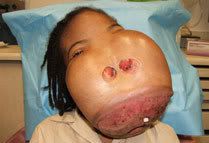
Things like not having a 7-kilo (15.4 pound) mass on your face like Marlie Casseus did. (This would probably more than double the weight of her head, for those of you keeping track at home.)

Or, if you are one of the unlucky few with a non-hereditary genetic disease called polyostotic fibrous dysplasia, that there exists such a thing as maxillofacial surgery, as well as charities that can help kids like Marlie Casseus (a 14-year-old Haitian girl), who don't have the money, have access to this surgery.

Polyostotic fibrous dysplasia is a disease that causes the bone to weaken and expand into a jelly-like substance with pockets of air and liquid that cause it to balloon out. In Marlie's case, this started visibly happening when she was 8, although it could have begun as young as 5. By the time she was 12, she no longer went to school. Her face was so distended that she could not talk or eat solid food, and she only had one good eye. Her nose had disappeared, leaving only her gaping nostrils visible.


But, like I said, the growth was able to be removed during a 17-hour surgery. It's great to have things to be thankful for, isn't it?

(To read the news article about Marlie, go here. Or, you can read more about fibrous dysplasia.)

Saturday, November 18, 2006

Count Fistula

You know something is going to be a Horrible Thing (and therefore of great interest to me) when the news article starts out like this:
"Nov. 13, 2006 - Warning: do not read this story if you are easily disturbed by graphic information, or are under age, or are easily upset by accounts of gruesome sexual violence."


Newsweek's World News reports on the problem of rape in Congo being used as a means of terrorism, to continue a war that is supposed to be over. But this isn't your garden-variety rape, here. These women have been raped and abused so badly that they've developed fistulas.

Fistulas (here, where the barrier between the vagina and the rectum or the vagina and the bladder is torn, connecting the two areas) are pretty rare in most parts of the world. Even really violent rapes don't usually cause fistulas. So when western doctors heard about the vast amount of fistula reports, they didn't believe it. Then they realized what was happening-- there is a vicious circle of almost ritualized rape in many areas of Congo, especially the countryside. One faction will raid a village, kill, rape the women, and leave. The surviving men raid the village supporting the first group and do the same. These groups each have a "signature" for when they rape women, which usually involves inserting something into the woman's vagina. Occasionally they even shoot the woman through the vagina, but they are careful not to kill her. They don't want to kill her, they want to cause as much damage as possible. These women will then become incontinent and infected, and almost certainly shunned by their society. Many will never be able to have children. Some can become continent again if they receive treatment and surgery-- others can't. I would like to point out that I have been using the term "woman" here loosely-- the victims are all ages. The oldest victim was 71. The youngest? Only 12 months old.